Overview
When critical components fail in legacy machinery, replacing them isn’t always straightforward. In many cases, original parts are no longer available, leaving operations at risk of costly downtime or expensive reengineering. This is where 3D printed spare parts can provide a solution.
Original components no longer being available was the challenge faced by Kocher & Beck – and where the practical, modern approach of 3D printing made all the difference.
The Challenge
Kocher & Beck rely on high-precision machinery to maintain consistent production quality. One of their chemical etching systems began to experience issues due to worn plastic sprockets.
The situation presented several challenges:
- The original components were no longer supplied by the manufacturer
- The parts needed to withstand exposure to ferric chloride, a highly corrosive chemical
- They also had to maintain strength and shape under continuous operating heat
- Early 3D-printed prototypes showed signs of warping under load
As the sprockets wore down, the machine’s performance deteriorated. Rollers no longer sat correctly in position, causing unstable and inconsistent operation.
Without a reliable replacement, the system risked further inefficiency and increased
operational costs.
Our Comprehensive Approach
After reviewing the application and constraints, we identified 3D printing as the most effective solution – balancing speed, cost, and performance. Rather than treating this as a simple part replacement, we focused on designing a solution that would perform reliably in real operating conditions.
1. Reverse Engineering & CAD Modelling
We created detailed CAD models based on the original components, ensuring dimensional accuracy and compatibility with the existing system.
2. Prototype Development & Testing
Initial prototypes were produced and tested under realistic conditions, allowing us to identify weaknesses early – particularly around heat resistance and structural integrity.
3. Material Selection
PETG was selected as the optimal material, offering:
- Strong chemical resistance
- Stability under elevated temperatures
- Durability for continuous operation
4. Design Refinement
Testing revealed that lattice infill structures were prone to distortion under heat.
To address this, we refined the design to use solid infill, significantly improving strength and long-term reliability.
The Outcome
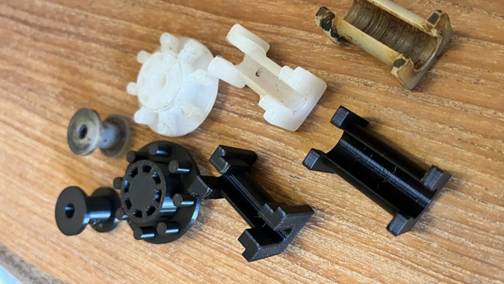
Following successful in-machine trials, the final components delivered on every requirement.
Key results included:
- Full machine functionality restored without OEM parts
- Reliable performance in both chemical and high-temperature environments
- Smooth, stable operation with improved roller alignment
- Repeatable production for future replacements
- Avoided tooling costs of approximately £10,000-£15,000 compared to injection moulding
Most importantly, the machine returned to consistent, efficient operation – removing the instability caused by worn components.
Client Feedback
“It is now nice and smooth and has already helped us reduce NC costs when using this machine. Very happy.”
– Robert Caffrey, Etching Supervisor, Kocher & Beck
Why This Matters
This project highlights a broader point many operations are now facing:
Legacy equipment doesn’t have to become a limitation.
With the right approach, modern manufacturing methods like 3D printing can:
- Extend the life of critical machinery
- Reduce reliance on unavailable OEM parts
- Deliver cost-effective, high-performance solutions
- Minimise downtime and disruption
It’s not about replacing entire systems – it’s about solving the right problem in the most practical way.
Looking Ahead
If you’re dealing with obsolete components or recurring machine issues, there are often more options than it first appears.
This project is a strong example of how a targeted, engineering-led approach can restore performance – without the need for major capital investment.
We also believe that additive manufacturing is stepping into a much bigger role within industrial settings – one that’s reshaping how businesses approach conveyor design in the UK. Read more about it here: 3D Printing in Conveyors: Beyond Spare Parts
Inspired by Kocher & Becks Story?
Get in touch with us to start your journey towards increased efficiency.
If you would like to read more case studies, thought pieces, or insights – check out our Knowledge Hub!
Contact us: sales@northgroup.tech 0345 017 9765