Introduction
In busy warehouse and distribution environments, efficiency often comes down to how quickly and safely goods can be handled. One process that plays a key role in this is pallet layer splitting.
If you’ve ever needed to separate part of a pallet load without unpacking it box by box, you’ve already encountered the challenge this method solves.
In this guide, we’ll break down what pallet layer splitting is, how it works, and where tools like a pallet changer, mobile pallet changer, or mobile pallet splitter fit into real-world operations.
What Is Pallet Layer Splitting?
Pallet layer splitting is the process of separating one or more layers of products from a stacked pallet load.
Instead of manually picking individual items, entire layers of goods are lifted, moved, or repositioned in one controlled action. This is commonly used in:
- Warehousing and distribution
- Food and beverage logistics
- Retail replenishment
- Manufacturing environments
Why Is Pallet Layer Splitting Important?
At first glance, splitting a pallet might seem like a small task. In reality, it can have a big impact on productivity and safety.
1. Faster Handling
Moving full layers is significantly quicker than manual picking, especially when dealing with high volumes.
2. Reduced Manual Labour
Operators don’t need to break down pallets by hand, reducing physical strain and repetitive tasks.
3. Improved Accuracy
Handling products in layers helps maintain organisation when dealing with multiple SKUs.
4. Safer Operations
Less manual handling means fewer risks of injury and product damage.
How Does a Pallet Layer Splitting System Work?
Most pallet layer splitting systems use controlled pressure and lifting mechanisms to secure and move part of a load.
A typical process looks like this:
- The pallet load is positioned within the machine
- Side press mechanisms gently clamp the product
- The selected layer (or layers) is lifted
- The remaining load stays in place or is transferred to another pallet
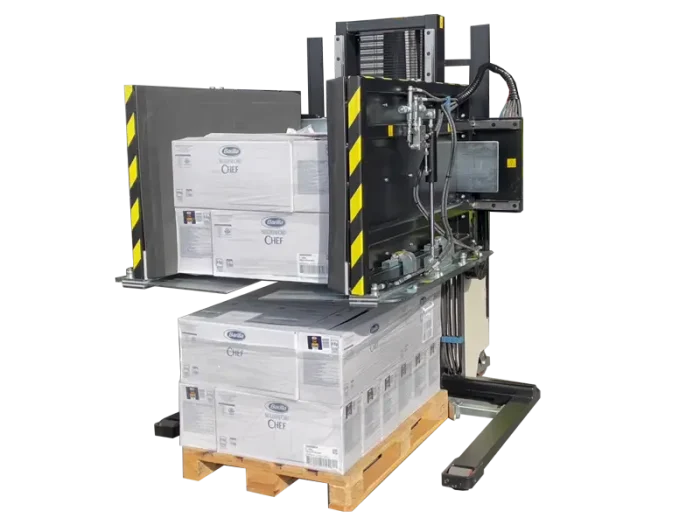
This method is often built into a pallet splitter or integrated into a pallet changer, allowing both pallet exchange and layer separation in one system.
For example, the Mobile Falcon Wings Splitter and the Mobile Side Press Splitter are both able to handle pallet changing and layer seperation together.
The Role of a Pallet Changer
A pallet changer is designed to transfer a full load from one pallet to another, often for hygiene, damage, or standardisation reasons.
However, many modern systems also include pallet layer splitting functionality, such as the examples mentioned previously (Mobile Falcon Wings Splitter and Mobile Side Press Splitter).
This means you can:
- Change the pallet beneath a load
- Split layers at the same time
- Rebuild or reorganise pallets efficiently
This dual functionality is particularly useful in operations where both pallet exchange and layer picking are required.
Mobile vs Stationary Solutions
When choosing equipment, one of the biggest decisions is whether to use a fixed system or a mobile pallet changer or mobile pallet splitter.
Mobile Pallet Changer / Mobile Pallet Splitter
- Can be moved around the warehouse
- Ideal for sites without a dedicated pallet handling area
- Flexible for changing workflows or seasonal demand
- Suitable for multiple locations within one facility
Stationary Systems
- Installed in a fixed position
- Better suited to high-volume, repeat processes
- Often integrated into automated lines
For many operations, mobility offers a practical starting point, especially where space or layout is limited.
When Should You Use Pallet Layer Splitting?
Pallet layer splitting is particularly useful when:
- You need to separate mixed loads into individual SKUs
- Products must be redistributed across multiple pallets
- Full pallets are too large or heavy for manual handling
- You want to speed up goods-in or dispatch processes
It’s also valuable in environments where hygiene matters, such as food or pharmaceutical operations, where loads may need to be transferred onto clean pallets without disruption.
When Pallets Are Too High for Racking
Another common reason for pallet layer splitting is when inbound pallets are too tall for your racking.
Instead of breaking them down manually, a pallet changer or mobile pallet splitter can remove one or more layers quickly and safely. The remaining load can then be stored at the correct height, while excess layers are placed onto a separate pallet.
This helps reduce manual handling, prevent product damage, and keep goods-in running smoothly.
What Types of Products Are Suitable?
Not every load behaves the same way, so product type matters.
Pallet layer splitting works best with:
- Boxes and cartons with flat, stable surfaces
- Uniform product sizes
- Loads that can be clamped safely using side press systems
Irregular or unstable products can still be handled, but may require more careful setup or alternative methods depending on the application.
Some systems have advanced features to aid in clamping less stable products. For example, the Mobile Falcon Wings Splitter uses extendable blades to stabilize loads from underneath.
Key Benefits at a Glance
To summarise, pallet layer splitting offers:
- Faster pallet handling
- Reduced manual labour
- Improved workplace safety
- Better organisation of mixed loads
- Greater flexibility in warehouse operations
When combined with a pallet changer or mobile pallet splitter, it becomes a powerful tool for improving overall workflow efficiency.
Real-World Example: How Pallet Layer Splitting Works in Practice
To see the impact of pallet layer splitting, imagine a warehouse receiving a mixed container of products.
Instead of unloading and sorting everything manually, operators can use a mobile pallet changer or mobile pallet splitter to handle the load more efficiently. As products come in, full layers can be separated and placed directly onto different pallets based on SKU.
For example, one pallet might contain beverages, while another holds packaged food items. Using a pallet splitter with a side press system, operators can gently clamp and lift each layer without disturbing the rest of the load.
This approach reduces handling time, keeps products organised, and removes the need for excessive manual picking. It also allows teams to prepare pallets for storage or dispatch much faster, especially in high-volume environments.
In practice, this means fewer delays at goods-in, better use of labour, and a smoother overall workflow.
Conclusion
Pallet layer splitting is a simple concept, but it can make a noticeable difference to how efficiently a warehouse operates.
By handling goods in layers rather than individual items, businesses can save time, reduce strain on operators, and improve consistency across their processes.
Whether you’re using a mobile pallet changer, a pallet splitter, or a fully integrated system, the goal is the same: to make pallet handling faster, safer, and more adaptable to your operation.